
Why virtual production is changing cardiology content

How a technology built for Hollywood is quietly revolutionising the way we communicate science
Cardiologists are among the most time-pressured, evidence-demanding audiences in medicine. They've sat through thousands of hours of congress presentations, device demonstrations, and talking-head interviews. They can tell within thirty seconds whether something is worth their attention.
Which makes the creative challenge in cardiology content brutally clear: it's not enough to be accurate. You have to be compelling. And compelling, in a world of shrinking attention and increasing content volume, increasingly means doing things differently.
Virtual production is one of those things.
What it actually is
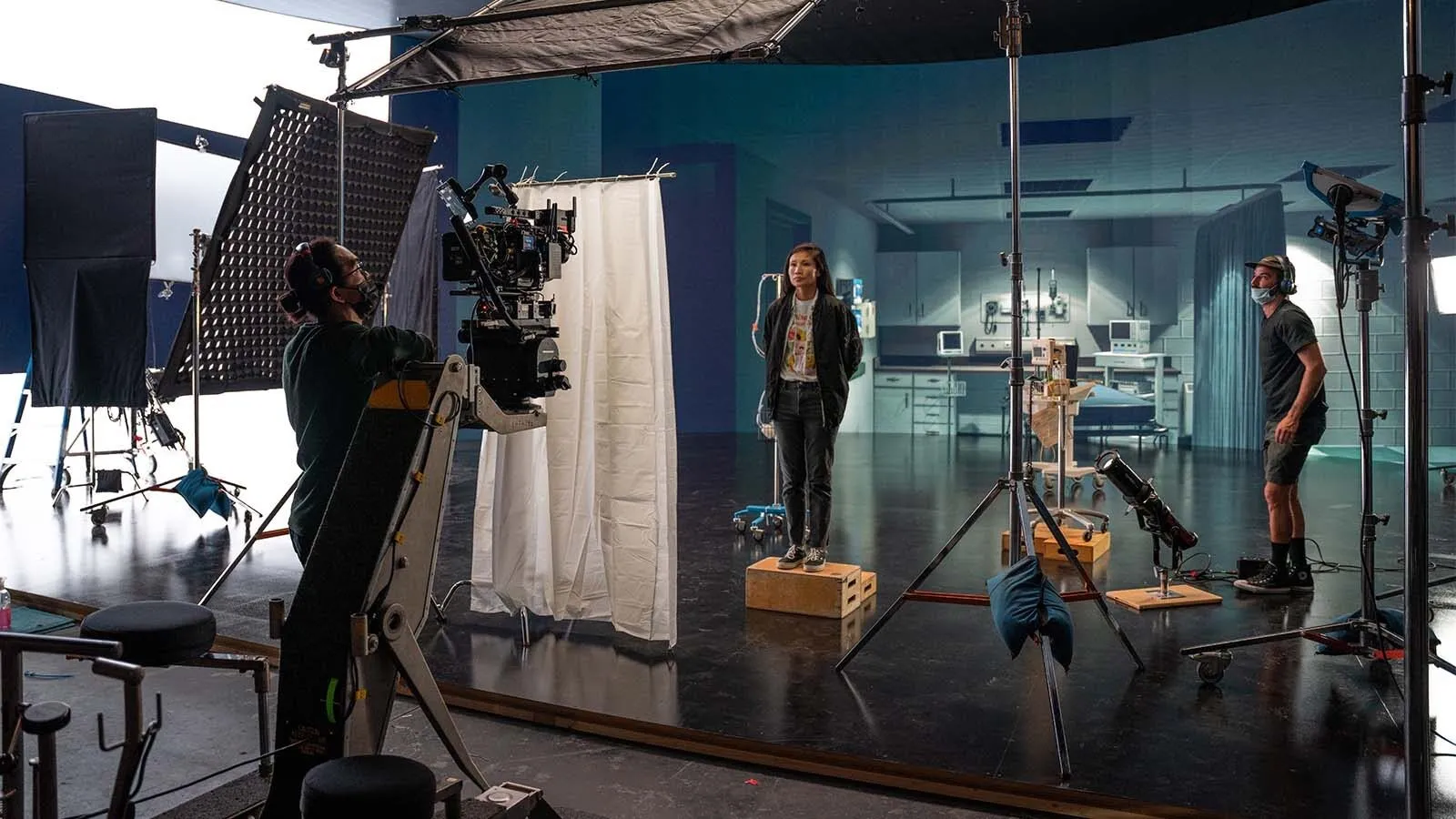
Virtual production uses real-time 3D environments, built in game engines like Unreal Engine 5, displayed on large LED volumes behind and around live actors. The camera sees a seamless world. The crew controls everything: the location, the lighting, the time of day, the atmosphere. It's the technology behind some of the most visually ambitious film and television being made right now, and it's increasingly accessible for content at our scale.
Location without compromise
Medical storytelling often demands environments that don't exist, are inaccessible, or are simply impractical to film in. A cellular pathway. A hospital corridor that needs to look a certain way. A patient's home that must feel universal yet specific. Virtual production means the environment serves the story, not the other way around. For complex scientific concepts, that's not a luxury; it's a fundamental creative requirement.
This extends to scale. One of VP's most powerful creative possibilities is the ability to move fluidly between the macro and the micro, from a clinical environment to the anatomy of a valve, from a physician's perspective to the cellular level where the science actually happens. That kind of visual storytelling is simply not possible with conventional production.
Real clinical environments, cath labs, catheterisation suites, hospital wards, present their own challenges. They're busy, they're constrained, and access is always limited. On a VP stage, we control the environment entirely. The set is built for the content, not the other way around.
Built to travel
One of VP's most underappreciated advantages is its modular nature. A digital location, once built, can be reused, adapted, and redeployed, across languages, markets, and campaigns. A cath lab environment created for a European launch can be redressed for a US physician education programme without rebuilding from scratch. For global cardiology brands working across territories, that's not just a creative asset, it's a meaningful efficiency.
The practical case
With the set built in Unreal, we can rehearse before the shoot: testing camera positions, working through blocking, identifying problems before they cost money on set. In a sector where physicians' time is precious and congress deadlines are unforgiving, arriving on set with certainty isn't a luxury, it's how you protect the clinical relationship.
And the lighting possibilities are genuinely extraordinary. Using DMX-controlled systems, we create dynamic environments where light shifts in real time with the action, not as a gimmick, but as a tool for making the story feel alive. For a sector that spends enormous effort making complex science feel tangible, that responsiveness matters.
The bigger point
Made Clear exists because we believe extraordinary science deserves extraordinary storytelling. Cardiology has both in abundance. The science is remarkable. The clinical need is real. The audiences are intelligent and motivated.
What's often missing is content that matches the ambition of the science, content that doesn't just inform, but lands. That changes how a cardiologist thinks about a device, or a procedure, or a patient.
Virtual production won't be the right tool for every brief. But for the ones where environment, atmosphere, and creative control are the difference between content that gets remembered and content that gets skipped, it's a tool that cardiology content has been waiting for.
Made Clear is the cardiology content agency. If you're working on a medical education programme, a device launch, or a congress moment and you want to talk about what's possible, we'd love to hear from you.
